
US PATENT 12,690,981
Minimally invasive systems for and methods of preparing and fusing a sacroiliac joint during interventional procedures
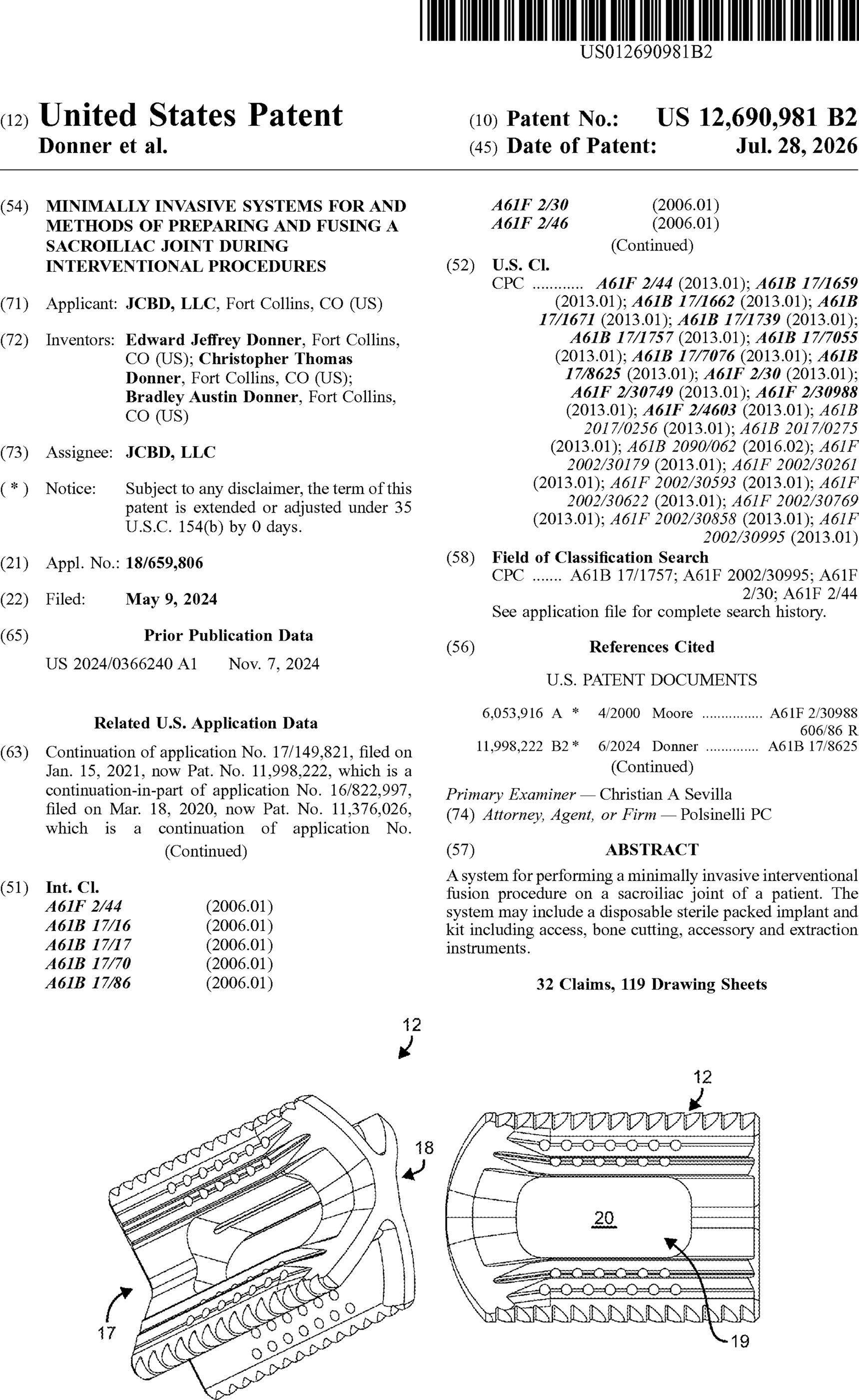
A system for performing a minimally invasive interventional fusion procedure on a sacroiliac joint of a patient. The system may include a disposable sterile packed implant and kit including access, bone cutting, accessory and extraction instruments.
CLAIMS
1. A sacroiliac joint implant comprising:
a distal end, a proximal end opposite the distal end, and a longitudinal axis extending centrally between the distal end and the proximal end, a first planar member comprising a first iliac member, a first sacral member extending from the first iliac member at a first midsection thereof, a first iliac side edge, a first sacral side edge opposite the first iliac side edge, a first iliac distal edge, a first sacral distal edge joined with the first iliac distal edge, a first iliac proximal edge, a first sacral proximal edge joining the first iliac proximal edge, a first iliac top surface, a first iliac bottom surface opposite the first iliac top surface, a first sacral top surface, and a first sacral bottom surface opposite the first sacral top surface, and a first aperture extending from the first iliac top surface and the first sacral top surface through the first planar member to the first iliac bottom surface and the first sacral bottom surface, wherein the first iliac top surface and the first sacral bottom surface each include at least one first fin extending between the proximal end and the distal end and terminating at a first distal section, the at least one first fin comprising a first trough and a first crest, the first trough positioned farther outward than the first crest from the longitudinal axis, the first distal section comprising an outward flaring of both the first trough and the first crest away from the longitudinal axis, a second planar member joined with the first planar member to form a generally X-shape cross-section transverse to the longitudinal axis.
2. The sacroiliac joint implant of claim 1, wherein the X-shape is a flattened X-shape.
3. The sacroiliac joint implant of claim 1, wherein the second planar member comprises a second iliac member, a second sacral member extending from the second iliac member at a second midsection thereof, a second iliac side edge, a second sacral side edge opposite the second iliac side edge, a second iliac distal edge, a second sacral distal edge joined with the second iliac distal edge, a second iliac proximal edge, a second sacral proximal edge joining the second iliac proximal edge, a second iliac top surface, a second iliac bottom surface opposite the second iliac top surface, a second sacral top surface, and a second sacral bottom surface opposite the second sacral top surface, and a second aperture extending from the second iliac top surface and the second sacral top surface through the second planar member to the second iliac bottom surface and the second sacral bottom surface, wherein the first planar member and the second planar member are joined at the first and second midsections, respectively.
4. The sacroiliac joint implant of claim 3, wherein the second sacral top surface and the second iliac bottom surface each include at least one second fin extending between the proximal end and the distal end and terminating at a second distal section, the at least one second fin comprising a second trough and a second crest, the second trough positioned farther outward than the second crest from the longitudinal axis, the second distal section comprising an outward flaring of both the second trough and the second crest away from the longitudinal axis.
5. The sacroiliac joint implant of claim 4, wherein a first obtuse angle is formed between the first iliac member and the second sacral member.
6. The sacroiliac joint implant of claim 5, wherein a second obtuse angle is formed between the second iliac member and the first sacral member.
7. The sacroiliac joint implant of claim 4, wherein a first acute angle is formed between the first iliac member and the second iliac member.
8. The sacroiliac joint implant of claim 5, wherein a first acute angle is formed between the first iliac member and the second iliac member.
9. The sacroiliac joint implant of claim 1, wherein the first distal section is beveled.
10. The sacroiliac joint implant of claim 4, wherein the first distal section and the second distal section are beveled.
11. The sacroiliac joint implant of claim 4, wherein each of the first iliac side edge, the first sacral side edge, the second iliac side edge, and the second sacral side edge includes a plurality of ridges thereon.
12. The sacroiliac joint implant of claim 11, wherein each of the plurality of ridges includes a distal face that is non-perpendicular to the longitudinal axis and a proximal face that is perpendicular to the longitudinal axis.
13. The sacroiliac joint implant of claim 1, wherein the outward flaring is about 7.5 degrees relative to the longitudinal axis.
14. The sacroiliac joint implant of claim 1, wherein each of the first iliac member and the first sacral member includes a distal section, a proximal section, and a transition point between the distal section and the proximal section, the distal section angling outward relative to the longitudinal axis at the transition point such that the distal end of the sacroiliac joint implant is wider than the proximal end of the implant.
15. The sacroiliac joint implant of claim 1, wherein the first iliac bottom surface and the first sacral top surface are devoid of the at least one first fin.
16. The sacroiliac joint implant of claim 4, wherein the first iliac bottom surface and the first sacral top surface are devoid of the at least one first fin, and wherein the second sacral bottom surface and the second iliac top surface are devoid of the at least one second fin.
17. The sacroiliac joint implant of claim 3, wherein the first aperture extends through the longitudinal axis and through a midpoint between the proximal end and the distal end.
18. The sacroiliac joint implant of claim 1, wherein the first trough includes a plurality of apertures extending through the first planar member.
19. A sacroiliac joint implant comprising:
a distal end, a proximal end opposite the distal end, and a longitudinal axis extending centrally between the distal end and the proximal end, an iliac side, a sacral side adjacent the iliac side, a top surface extending across the iliac side and the sacral side, a bottom surface opposite the top surface and extending across the iliac side and the sacral side, an iliac side surface, a sacral side surface opposite the iliac side surface, a first aperture extending from the top surface to the bottom surface, a second aperture extending from the iliac side surface to the sacral side surface and extending through the first aperture, and wherein each of the sacral side and the iliac side includes, on the top surface, at least one first fin extending between the proximal end and the distal end and terminating at a first distal section, the at least one first fin comprising a first trough and a first crest, the first trough positioned farther outward than the first crest from the longitudinal axis, the first distal section comprising an outward flaring of both the first trough and the first crest away from the longitudinal axis.
20. The sacroiliac joint implant of claim 19, wherein each of the sacral side and the iliac side includes, on the bottom surface, at least one second fin extending between the proximal end and the distal end and terminating at a second distal section, the at least one second fin comprising a second trough and a second crest, the second trough positioned farther outward than the second crest from the longitudinal axis, the second distal section comprising an outward flaring of both the second trough and the second crest away from the longitudinal axis.
21. The sacroiliac joint implant of claim 20, wherein the outward flaring is about 7.5 degrees relative to the longitudinal axis.
22. The sacroiliac joint implant of claim 20, wherein each of the iliac side surface and the sacral side surface includes a distal section, a proximal section, and a transition point between the distal section and the proximal section, the distal section angling outward relative to the longitudinal axis at the transition point such that the distal end of the sacroiliac joint implant is wider than the proximal end of the implant.
23. The sacroiliac joint implant of claim 22, wherein the sacroiliac joint implant defines a generally X-shaped body having an opened midsection defined by the first and second apertures.
24. A sacroiliac joint implant comprising:
a distal end, a proximal end opposite the distal end, and a longitudinal axis extending centrally between the distal end and the proximal end, and an implant body extending a length between the distal and proximal ends and comprising: a central core portion disposed along the longitudinal axis, a first, second, third, and fourth fixation member each of which extends outwardly from and connects to the central core portion and each of which extends the length, wherein each of the first fixation member and the second fixation member comprises at least one exterior surface having at least one stepped projection disposed thereon and extending along the implant body between the proximal and distal ends, wherein each of the at least one stepped projection comprises a riser portion and a tread portion, the riser portion extending outward from the at least one exterior surface from which it is disposed and the tread portion extending generally perpendicular to the riser portion; and wherein each of the at least one stepped projection, while extending along the implant body between the proximal and distal ends, extends parallel to the longitudinal axis from the proximal end up until a transition point where each of the at least one stepped projection then forms a diverging angle to the longitudinal axis.
25. The sacroiliac joint implant of claim 24, wherein the first, second, third, and fourth fixation members are arranged around the longitudinal axis such that a first obtuse angle is formed between the first fixation member and the second fixation member, a first acute angle is formed between the second fixation member and the third fixation member, and a second acute angle is formed between the fourth fixation member and the first fixation member.
26. The sacroiliac joint implant of claim 24, wherein the implant body defines a generally X-shaped cross-section as viewed along the longitudinal axis.
27. The sacroiliac joint implant of claim 24, further comprising a first window positioned between the proximal and distal ends and extending generally perpendicular to the longitudinal axis and extending through each of the first, second, third and fourth fixation members and the central core portion, and a second window positioned between the proximal and distal ends and extending generally perpendicular to both the longitudinal axis and the first window and extending through the central core portion, wherein the first and second windows are coincident with each other.
28. A sacroiliac joint implant comprising:
a distal end, a proximal end opposite the distal end, and a longitudinal axis extending centrally between the distal end and the proximal end, and an implant body extending a length between the distal and proximal ends and comprising: a central core portion disposed along the longitudinal axis, a first, second, third, and fourth fixation member each of which extends outwardly from and connects to the central core portion and each of which extends the length, wherein each of the first fixation member and the second fixation member comprises at least one exterior surface having at least one trough disposed thereon and extending along the implant body between the proximal and distal ends; and wherein each of the at least one trough, while extending along the implant body from the proximal end to distal end, forms a diverging angle to the longitudinal axis such that a distal trough portion is located farther from the longitudinal axis than a proximal trough portion.
29. The sacroiliac joint implant of claim 28, wherein each of the at least one trough extends parallel to the longitudinal axis from the proximal end up until a transition point where each of the at least one trough then forms the diverging angle to the longitudinal axis.
30. The sacroiliac joint implant of claim 28, wherein the first, second, third, and fourth fixation members are arranged around the longitudinal axis such that a first obtuse angle is formed between the first fixation member and the second fixation member, a first acute angle is formed between the second fixation member and the third fixation member, and a second acute angle is formed between the fourth fixation member and the first fixation member.
31. The sacroiliac joint implant of claim 28, wherein the implant body defines a generally X-shaped cross-section as viewed along the longitudinal axis.
32. The sacroiliac joint implant of claim 28, further comprising a first window positioned between the proximal and distal ends and extending generally perpendicular to the longitudinal axis and extending through each of the first, second, third and fourth fixation members and the central core portion, and a second window positioned between the proximal and distal ends and extending generally perpendicular to both the longitudinal axis and the first window and extending through the central core portion, wherein the first and second windows are coincident with each other.