
US PATENT 12,569,262
Decortication Instrumentation For Posterior Sacroiliac Joint Fusion
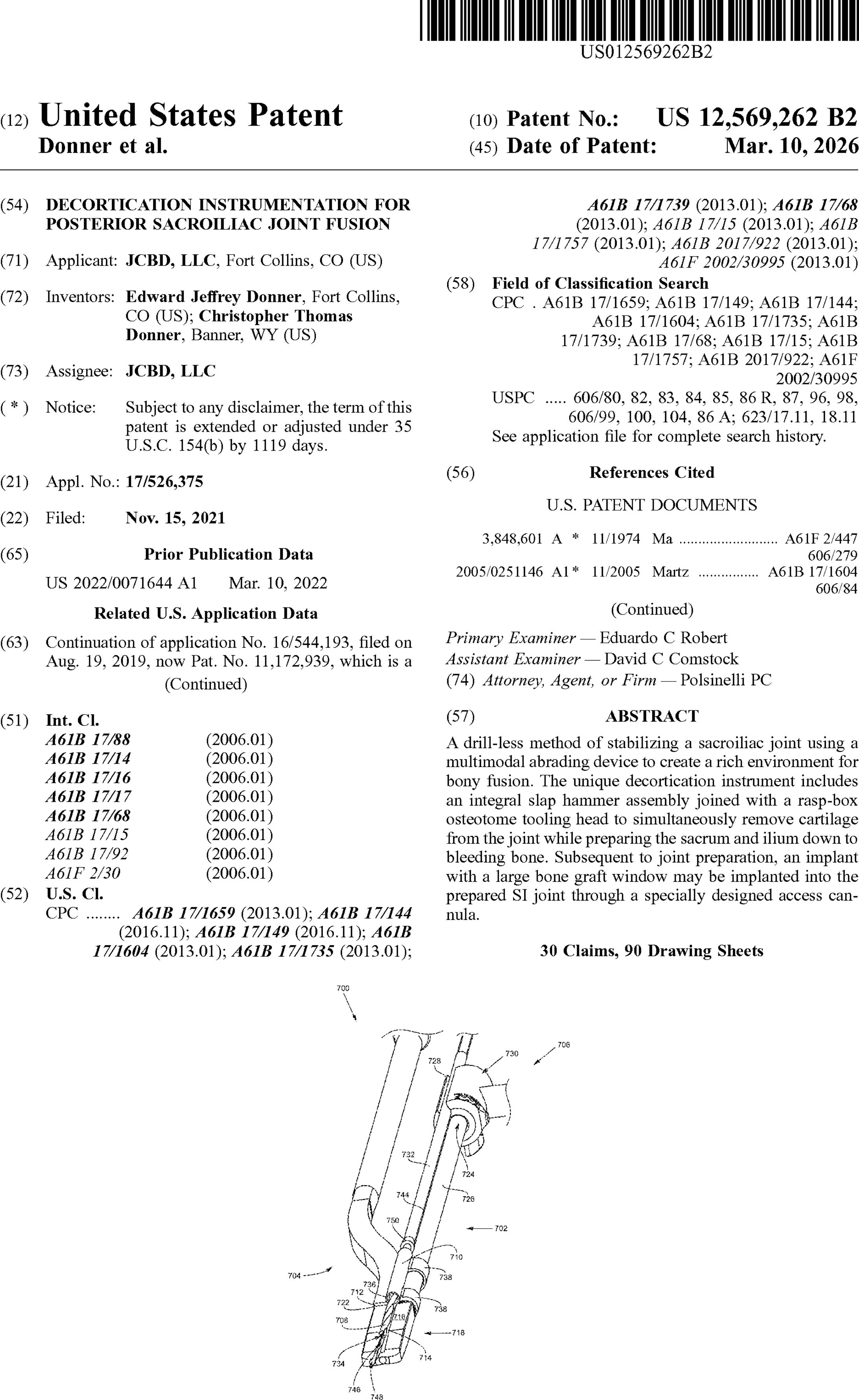
A drill-less method of stabilizing a sacroiliac joint using a multimodal abrading device to create a rich environment for bony fusion. The unique decortication instrument includes an integral slap hammer assembly joined with a rasp-box osteotome tooling head to simultaneously remove cartilage from the joint while preparing the sacrum and ilium down to bleeding bone. Subsequent to joint preparation, an implant with a large bone graft window may be implanted into the prepared SI joint through a specially designed access cannula.
CLAIMS
1. A method of surgically preparing a sacroiliac joint having a sacrum, an ilium, and a sacroiliac joint space defined therebetween for a surgical fusion procedure, the method comprising:
a) approaching the sacroiliac joint space with a joint preparation tool comprising:
i) a proximal end, a distal end, a cutting element supported at the distal end, a shaft extending proximally from the cutting element, and a slap hammer assembly supported at the proximal end; and
ii) the cutting element comprising a length extending between a proximal cutting element end and a distal cutting element end, a cutting element exterior surface having an abrading texture configured to abrade the sacroiliac joint, and a distal opening leading to a cutting element interior cavity in which is bounded by four walls and configured to receive tissue therein;
b) delivering a portion of the cutting element non-transversely into the sacroiliac joint space;
c) removing the cutting element from the sacroiliac joint space by proximally sliding the slap hammer assembly thereby forcing the joint preparation tool proximally; and
d) implanting an implant into the sacroiliac joint space.
2. The method of claim 1, wherein at least one wall of the four walls comprises an opening into the interior cavity configured to facilitate removal of biologic material received within the interior cavity.
3. The method of claim 2, further comprising: positioning a cannula up to the sacroiliac joint, the cannula configured to facilitate access to the sacroiliac joint space and comprising a cannula body including a distal end comprising at least one contoured area structured to enhance a close fit of the cannula with one of the sacrum and the ilium.
4. The method of claim 3, wherein the at least one contoured area includes a first contoured area comprising a sacral contour.
5. The method of claim 4, wherein the sacral contour curves proximally from the distal end of the cannula body.
6. The method of claim 5, further comprising passing the implant through the cannula.
7. The method of claim 3, wherein the at least one contoured area includes a second contoured area comprising an iliac contour.
8. The method of claim 7, wherein the iliac contour curves proximally from the distal end of the cannula body.
9. The method of claim 8, further comprising passing the implant through the cannula.
10. The method of claim 3, wherein the at least one contoured area includes a first contoured area comprising a sacral contour and a second contoured area comprising an iliac contour, wherein the iliac contour and the sacral contour curves proximally from the distal end of the cannula body.
11. The method of claim 10, further comprising passing the implant through the cannula.
12. The method of claim 1, wherein the abrading texture comprising a repeating pattern of protrusions defining a rasp band.
13. A method of surgically preparing a sacroiliac joint having a sacrum, an ilium, and a sacroiliac joint space defined therebetween for a surgical fusion procedure, the method comprising:
preparing the sacroiliac joint by delivering a portion of a cutting element non-transversely into the sacroiliac joint space,
the cutting element being part of a joint preparation tool including a tool shaft extending proximally from the cutting element, a first handle portion operably coupled to the tool shaft, and a second handle portion operably engaged with the tool shaft and moveable relative to the first handle portion, the cutting element comprising an external surface having an abrading texture, and a distal opening leading to an interior cavity configured to receive tissue therein;
removing the cutting element from the sacroiliac joint space by moving the second handle portion relative to the first handle portion; and
implanting an implant into the sacroiliac joint space.
14. The method of claim 13, wherein the cutting element includes a sacral face and an iliac face generally opposite of the sacral face, the abrading texture defined on both the sacral face and the iliac face.
15. The method of claim 13, wherein the abrading texture is defined on only a portion of the external surface.
16. The method of claim 13, further comprising: positioning a working cannula up to the sacroiliac joint, the working cannula configured to facilitate access to the sacroiliac joint space and comprising a cannula body including a distal end comprising at least one contoured area structured to enhance a close fit of the cannula with one of the sacrum and the ilium.
17. The method of claim 16, wherein the at least one contoured area includes a first contoured area comprising an iliac contour.
18. The method of claim 17, further comprising passing the implant through the cannula.
19. The method of claim 16, wherein the at least one contoured area includes a second contoured area comprising a sacral contour.
20. The method of claim 19, further comprising passing the implant through the cannula.
21. The method of claim 13, wherein the cutting element enters and abrades an extra-articular region of the sacroiliac joint space.
22. The method of claim 21, wherein the implant crosses a boundary of the extra-articular region when implanting the implant into the sacroiliac joint space.
23. The method of claim 13, wherein the implant is at least partially implanted in an extra-articular space and the implant accesses the extra-articular space via an extra-articular recess access region.
24. The method of claim 13, wherein the joint preparation tool includes a slap hammer assembly at a proximal end thereof.
25. The method of claim 13, wherein the second handle portion is slidable relative to the first handle portion.
26. A method of surgically preparing a sacroiliac joint having a sacrum, an ilium, and a sacroiliac joint space defined therebetween for a surgical fusion procedure, the method comprising:
preparing the sacroiliac joint by delivering a portion of a cutting element non-transversely into the sacroiliac joint space,
the cutting element being part of a joint preparation tool including a tool shaft extending proximally from the cutting element, a first handle portion operably coupled to the tool shaft, and a second handle portion operably engaged with the tool shaft and moveable relative to the first handle portion, the cutting element comprising an external surface having an abrading texture, and a distal opening leading to an interior cavity configured to receive tissue therein;
removing the cutting element from the sacroiliac joint space by moving the second handle portion relative to the first handle portion; and
implanting an implant into the sacroiliac joint space, wherein the interior cavity is bounded by four walls and at least one wall of the four walls comprises an opening into the interior cavity configured to facilitate removal of biologic material received within the interior cavity.
27. The method of claim 26, wherein the cutting element comprises a first length, a first height, and a first width, wherein the first length is greater than the first height and the first height is greater than the first width, and wherein the implant comprises a second length, a second height and a second width, wherein the second length is greater than the second height and the second height is greater than the second width.
28. A method of surgically preparing a sacroiliac joint having a sacrum, an ilium, and a sacroiliac joint space defined therebetween for a surgical fusion procedure, the method comprising:
preparing the sacroiliac joint by delivering a portion of a cutting element non-transversely into the sacroiliac joint space,
the cutting element being part of a joint preparation tool including a tool shaft extending proximally from the cutting element, a first handle portion operably coupled to the tool shaft, and a second handle portion operably engaged with the tool shaft and moveable relative to the first handle portion, the cutting element comprising an external surface having an abrading texture, and a distal opening leading to an interior cavity configured to receive tissue therein;
removing the cutting element from the sacroiliac joint space by moving the second handle portion relative to the first handle portion; and
implanting an implant into the sacroiliac joint space, wherein the cutting element further comprises a side opening extending through the external surface into the interior cavity, the side opening oriented on the cutting element in a transverse orientation relative to the distal opening.
29. A method of surgically preparing a sacroiliac joint having a sacrum, an ilium, and a sacroiliac joint space defined therebetween for a surgical fusion procedure, the method comprising:
preparing the sacroiliac joint by delivering a portion of a cutting element non-transversely into the sacroiliac joint space,
the cutting element being part of a joint preparation tool including a tool shaft extending proximally from the cutting element, a first handle portion operably coupled to the tool shaft, and a second handle portion operably engaged with the tool shaft and moveable relative to the first handle portion, the cutting element comprising an external surface having an abrading texture, and a distal opening leading to an interior cavity configured to receive tissue therein;
removing the cutting element from the sacroiliac joint space by moving the second handle portion relative to the first handle portion;
delivering a pin into the sacroiliac joint space;
advancing a cannulated probe and a working cannula over the pin and up to the sacroiliac joint, the cannulated probe including a length between distal and proximal ends, a shaft extending the length, a cannulation extending through the shaft, and a handle at the proximal end, the cannulation receiving the pin therein, the working cannula including a tubular body including an interior passageway, at least one of an iliac contour and a sacral contour, and a distal projection, the interior passageway receiving the cannulated probe therein;
removing the cannulated probe from the interior passageway of the tubular body of the working cannula;
passing the cutting element through the interior passageway of the tubular body of the working cannula;
grasping an implant with an implant inserter including a handle at a proximal end and an implant engagement structure at a distal end, the implant comprising a pair of indentations, the implant engagement structure engaging the pair of indentations on the implant; and
implanting the implant into the sacroiliac joint space.
30. A method of surgically preparing a sacroiliac joint having a sacrum, an ilium, and a sacroiliac joint space defined therebetween for a surgical fusion procedure, the method comprising:
preparing the sacroiliac joint by delivering a portion of a cutting element non-transversely into the sacroiliac joint space,
the cutting element being part of a joint preparation tool including a tool shaft extending proximally from the cutting element, a first handle portion operably coupled to the tool shaft, and a second handle portion operably engaged with the tool shaft and moveable relative to the first handle portion, the cutting element comprising an external surface having an abrading texture, and a distal opening leading to an interior cavity configured to receive tissue therein;
removing the cutting element from the sacroiliac joint space by moving the second handle portion relative to the first handle portion; and
implanting an implant into the sacroiliac joint space, wherein the implant comprises:
a body comprising:
a proximal end;
a distal end;
a length extending between the distal end and the proximal end;
a height;
a width;
an external surface having at least one anti-migration feature;
a window extending through the body transverse to the length;
a rounded nose at the distal end; and
a pair of indentations extending distally from the proximal end configured to be engaged by an implant engagement structure of an implant inserter;
the length being within a range of about 20 mm to about 30 mm;
the height being within a range of about 10 mm to about 12 mm;
the width being within a range of about 7 mm to about 9 mm; and
the window including a window length within a range of about 10 mm to about 20 mm.